
The Continental Divide
The bar theory says South American teams can't win in Europe and Europeans can't win in South America. The 2026 World Cup runs on a continent that is neither. We strip out home-field advantage across 49,378 men's internationals to see what survives the trip.
- -6.2%
- CONMEBOL goals/match on neutral European soil
- +5.7%
- UEFA goals/match on neutral S. American soil
- -14%
- UEFA scoring drop at cups on North American soil
- 49,378
- men's internationals analyzed since 1872
Written before the final
This piece went up before Argentina and Spain met in the 2026 World Cup final at MetLife. The numbers below are what the 90-year dataset predicted going in.
Every football bar on earth has had this argument. South Americans can't win in Europe. Europeans can't win in South America. The Kaggle file says we can finally check.
The bar theory, and what we can actually test
The dataset is the Kaggle mirror of international football results from 1872 to present: every men's senior international, date, scoreline, host city, host country, and a flag that says whether the venue was neutral. 49,378 matches. Nothing else. No pass maps, no possession, no xG.
We tag each team with its confederation - CONMEBOL (the 10 South American federations) or UEFA (55 European) - and each match with its host continent. Then we ask one question: when a CONMEBOL side plays on European soil, or a UEFA side plays on South American soil, do the goals go missing?
On neutral ground, only one side of the myth survives
Home-field advantage in international football is roughly half a goal per match. That makes the “all venues” comparison mostly a measurement of who happened to be hosting. So we throw out every home and away match and keep only neutral-site games - friendlies in a third country, group stages in a tournament neither side is hosting, the showcases the calendar produces every cycle.
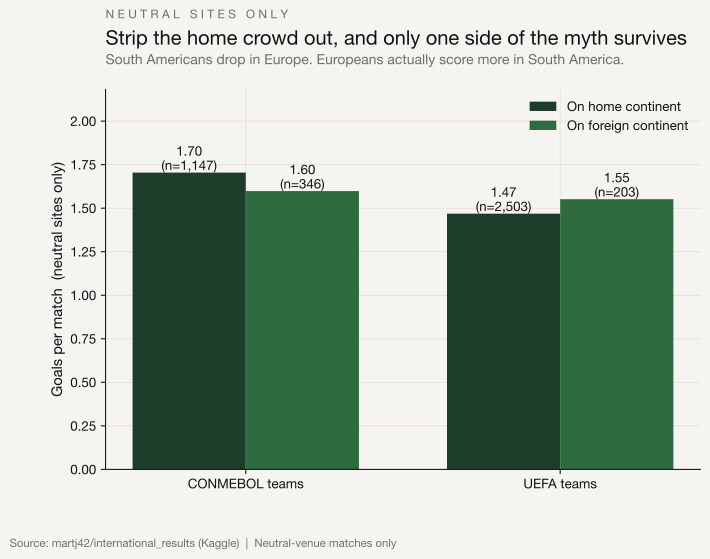
CONMEBOL teams on neutral European soil score 1.60 goals per match, down from 1.70 at neutral sites on their own continent - a drop of 6.2%. Small, but in the direction the bar theory predicts.
UEFA teams on neutral South American soil score 1.55 goals per match, which is more than the 1.47 they score at neutral sites in Europe - up 5.7%. That is the opposite of what the bar theory predicts. The sample is smaller than the other direction - 203 European team-matches on neutral South American soil vs 346 the other way - and it leans on the four World Cups South America has hosted, so the +5.7% should be read as “no penalty visible” rather than a confirmed boost.
One caveat that applies to every number in this section: CONMEBOL is ten hyper-divergent federations, from La Paz at 3,640 m to Buenos Aires at sea level. The aggregate absorbs the altitude cases; the fair like-for-like sits in Section 04, where we zoom into the big-five sides.
The gap is small, asymmetric, and not getting bigger
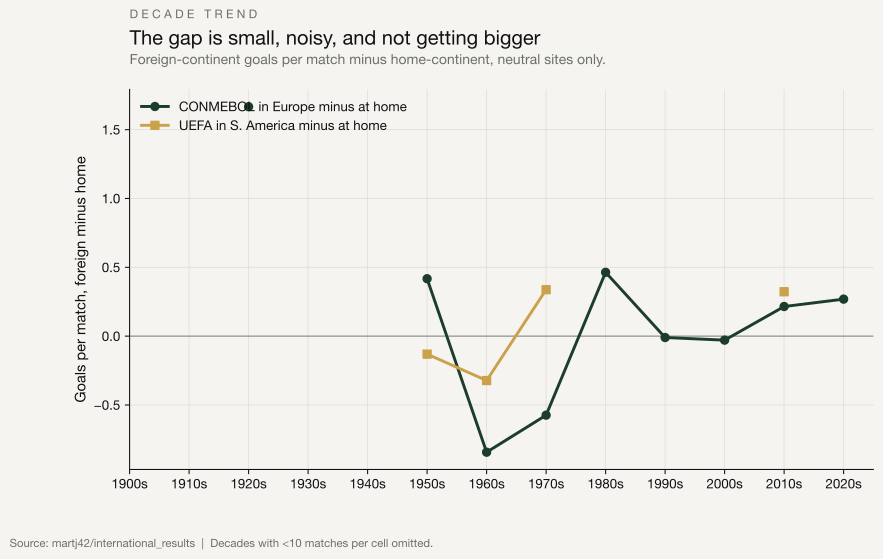
One reading is that jet travel, modern recovery, and ten weeks of a European club season inside every CONMEBOL squad have erased the climate gap. Since the 1995 Bosman ruling this has gotten structural: most of the Brazil, Argentina and Uruguay first XI now live in Europe year-round. When those sides play a “neutral” friendly in London or Geneva they are the ones who traveled less. The decade-by-decade trend supports that for CONMEBOL: a brutal 1960s and 1970s in Europe, then a long flatten toward parity since the 1990s.
The UEFA line, meanwhile, oscillates around zero with no trend at all. The bar theory was never symmetric. Europeans travel and score. South Americans travel slightly less well - but only barely. Whatever made crossing the Atlantic difficult in the 1960s is mostly gone for South America; it never really existed for Europe in the first place.
The big five lose almost nothing crossing the Atlantic
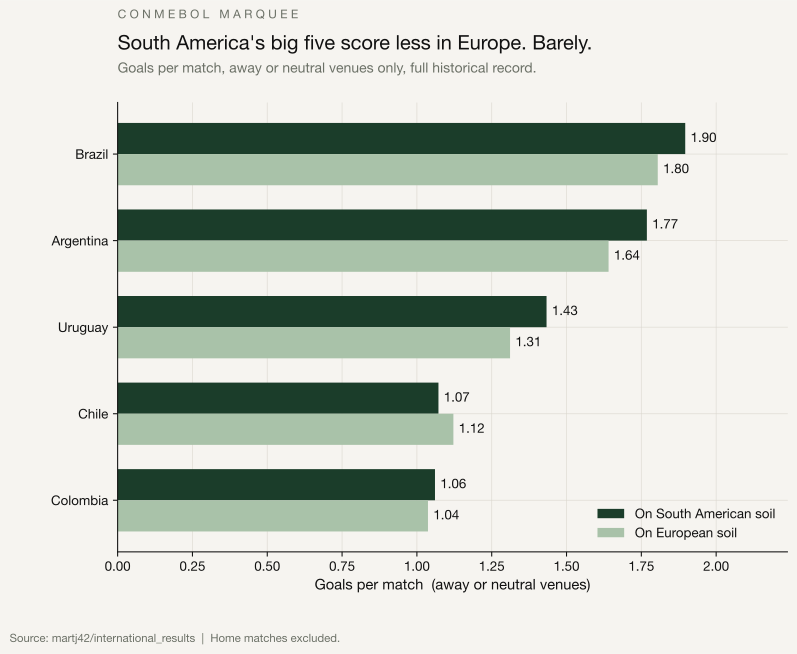
Zoom in on the marquee CONMEBOL sides - Brazil, Argentina, Uruguay, Chile, Colombia - and the gap stays small at the team level too. Brazil scores 1.90 per match on South American soil (away or neutral) and 1.80 in Europe. Argentina, 1.77 vs 1.64. Uruguay, 1.43 vs 1.31.
Chile actually scores marginally more in Europe than at home. So does Colombia, within a goal or two of noise. None of these are knockout blows. They are accountants' numbers.
The away crowd was always blamed. Empty the stadium, and the gap is mostly gone - except in the one tournament that everyone is watching.
England's scoring halves on South American soil
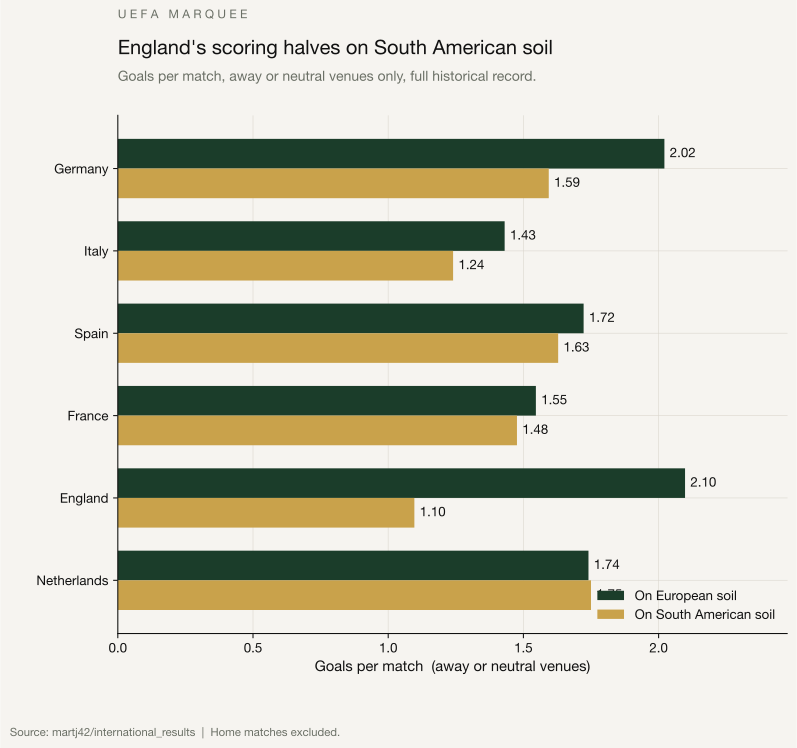
For most of UEFA's marquee sides the South American trip is uneventful. Germany dips from 2.02 to 1.59. Italy from 1.43 to 1.24. Netherlands is essentially flat (1.74 at home, 1.75 in South America). Spain, France - all within a tenth of a goal.
And then there is England, the team whose entire football identity was forged in the rain. On European soil England scores 2.10 goals per match; on South American soil, 1.10. A 47% collapse. Across a sample of 31 matches, the pattern is persistent rather than being driven by a single tournament. It is the largest single-team gap in this dataset.
At the World Cup, both sides drop
The World Cup is the closest thing this dataset has to a controlled experiment. Every four years the tournament moves continents. Every team plays it at full intensity. The crowd is mixed.
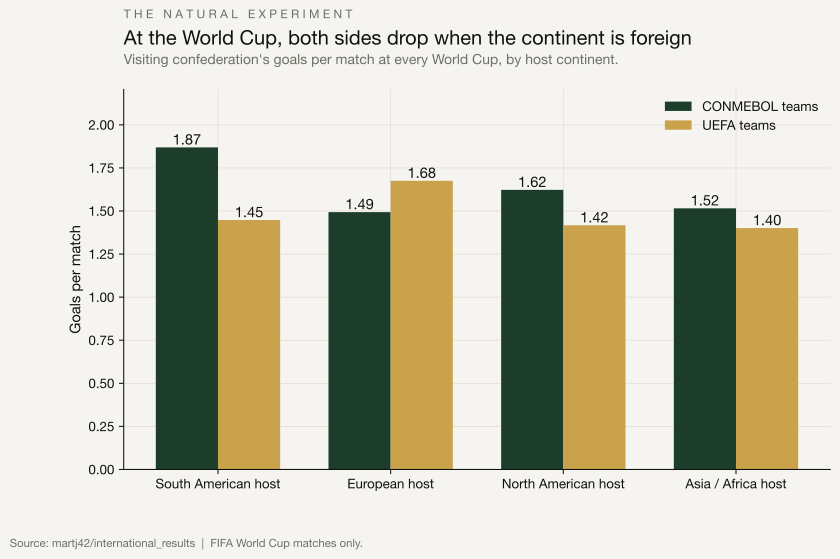
At World Cups hosted in South America, CONMEBOL teams score 1.87 goals per match; at World Cups in Europe they score 1.49 - a 20% drop. UEFA teams score 1.67 per match at home World Cups and only 1.45 at South American ones - a 14% drop. The bar theory, finally, with both sides on it.
Whatever causes the gap, it appears only once the tournament begins. The same Brazil that beats up on Switzerland in a Geneva friendly looks ordinary in Doha when three points decide a group.
The 2026 World Cup is on a continent that is neither
Every section so far has been CONMEBOL on European soil or UEFA on South American soil. Next summer's World Cup is on neither. The closest historical analogues are the 1994 World Cup in the United States and the three Copas America held there (the Centenario tournament and the 2024 edition). Together: 300 cup matches on North American soil, away or neutral, for the two confederations the bar theory is about.
CONMEBOL teams in those matches score 1.53 goals per match. That is nearly identical to their cup baseline at home (1.52) and almost identical to their cup average in Europe (1.49). For South America, the continent does not matter. They travel and they score.
UEFA teams on North American cup soil score 1.42, down from 1.65 at home cups - a 14% drop, slightly worse than their 12% drop at South American cups. The pattern is consistent: whenever Europe leaves Europe for a major tournament, the goals get harder to come by.
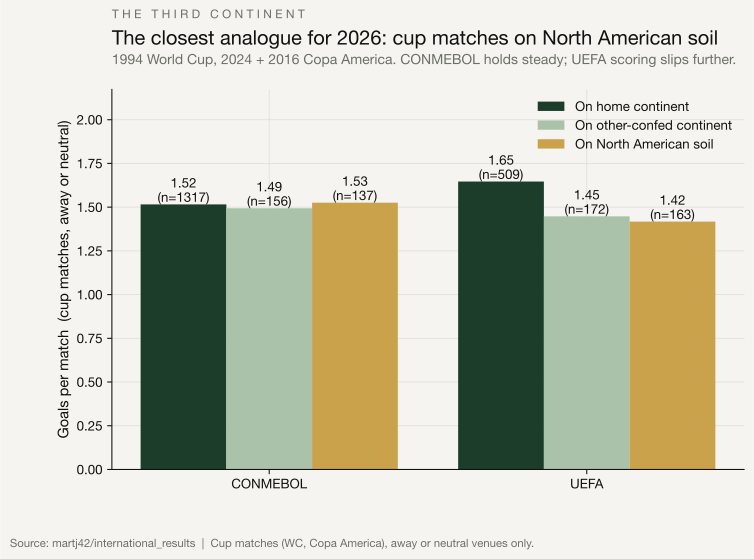
Read the two numbers side by side and the 2026 story writes itself: CONMEBOL 1.53, UEFA 1.42 per match on North American cup soil. Same continent, same tournaments, opposite reactions. Argentina and Spain settle the tournament today at MetLife. If 1994 is any guide, the side that arrived in New Jersey with the most adjusting to do is not the one the bar theory warns about.
The bar theory is half a myth, and one tournament
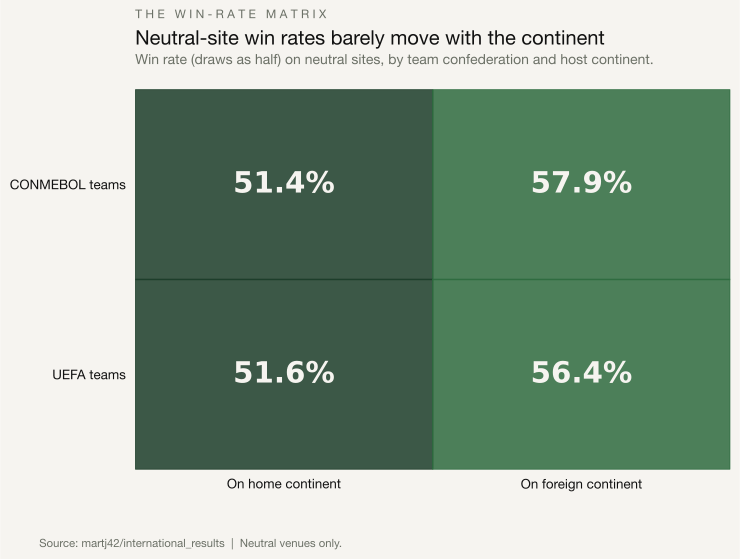
Strip out the home crowd, and the legend is mostly noise. CONMEBOL teams lose six percent of their scoring on European soil. UEFA teams lose nothing on South American soil; they may actually gain. Win rates on neutral sites barely move at all: CONMEBOL wins 51.4% at home and 57.9% on foreign soil; UEFA wins 51.6% at home and 56.4% on foreign soil. Both sides do slightly better once they cross the Atlantic - the 2x2 the bar theory predicts is upside down in three of four cells.
What is real is the World Cup gap, and the goals are a coarse instrument that cannot explain it. Altitude, humidity, jet-lag, referee tendencies, the way the ball sits at the edge of the box when 50,000 strangers want a different result - the dataset can see the gap but not the cause.
One thing it can rule out is the climate. The continent is the same continent it was on Wednesday for the friendly. The thing that changed is the tournament.